About one in four early founding engineers who started in 2024 left within a year
A founding engineer is usually one of a startup's first engineering hires, yet there is little hard data on who takes the title, how long they stay or what they do next.
Want this cut for your own companies, roles or region?
Live Data Technologies looked at the public job histories of 15,009 people in the US who have held the title since 2015, 16,827 jobs in all.
On this page an early founding engineer is the first person with the title that we can see at a company, or anyone who joined within a year of them. Left means they no longer had any job at that company.
The newest years are marked "still being recorded": job changes take months to show up in public information, so those figures can still go up or down.
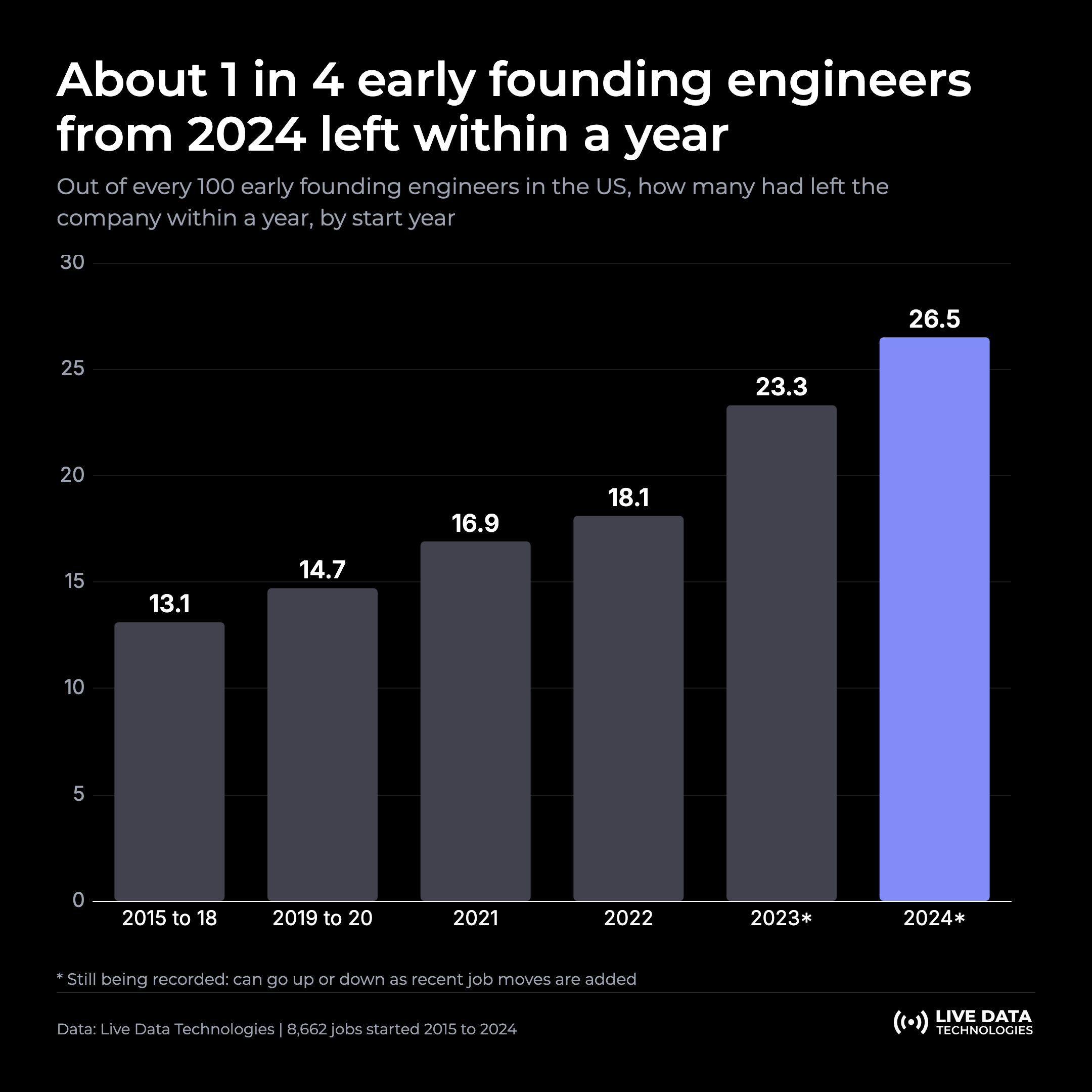
About 1 in 4 early founding engineers who started in 2024 left within a year, against about 1 in 8 for 2015 to 2018 starters
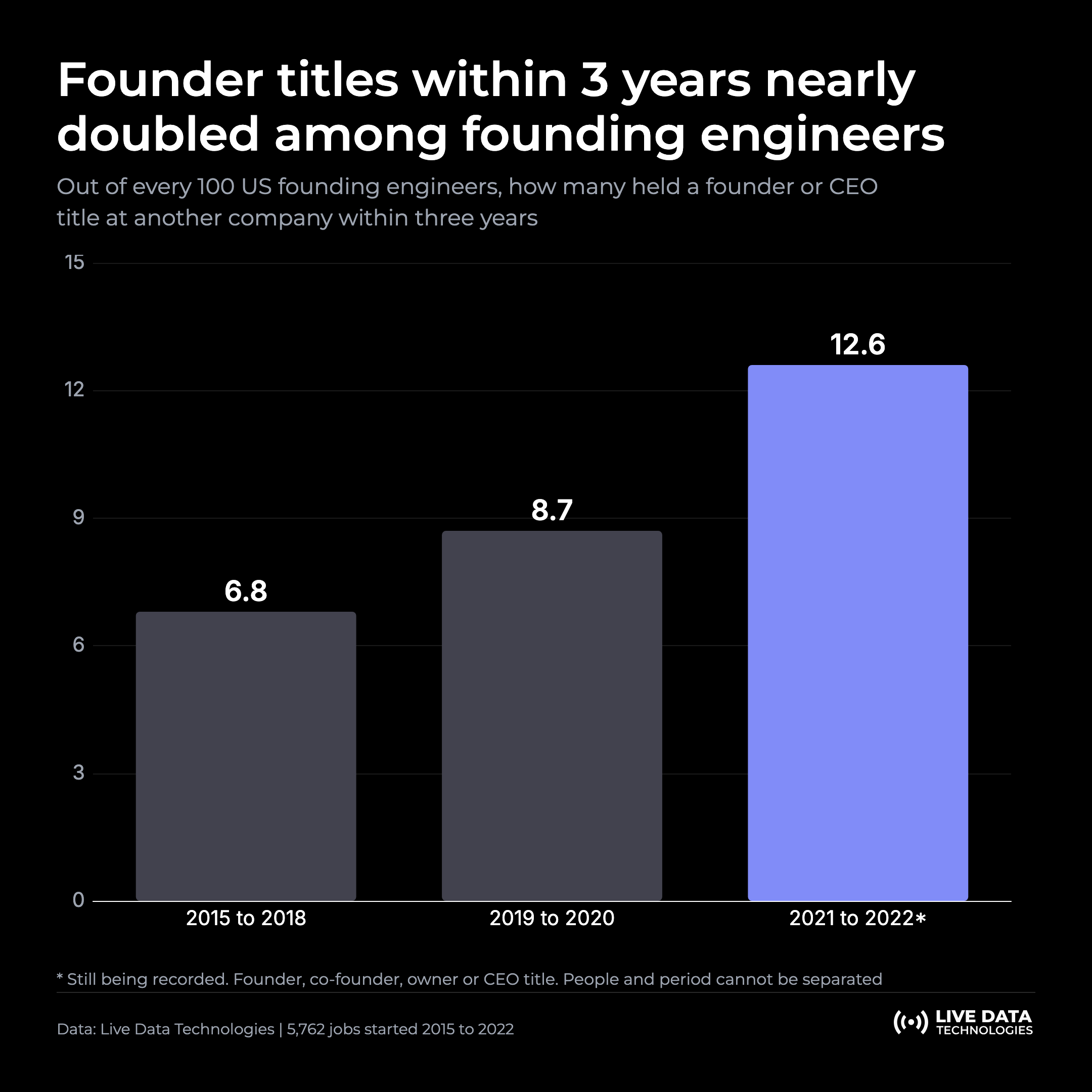
About 1 in 8 who started in 2021 or 2022 held a founder, co-founder, owner or CEO title at another company within three years
Nearly 1 in 4 founding engineer jobs went to someone joining a company that already had one
What is a founding engineer?
A founding engineer is usually one of the first engineers a startup hires, brought in to build the first version of the product alongside the founders; in Live Data Technologies data on 16,827 founding engineer jobs held by 15,009 people in the US since 2015, two in three went to the earliest founding engineer at the company.
They are employees, not founders. In common startup practice the title marks when someone joined rather than how senior they are, and it usually comes with a larger equity grant than later hires get, though far smaller than the founders' stakes. This data does not cover equity.
So most of the time the title means what people assume. But not always: some companies give it to their whole early team, keep using it for engineers who join years later, or use it for the first engineers on a new product. The section on the first engineer below has the numbers.
How we counted.
We looked for people based in the US with a job titled Founding Engineer or a close variant, such as Founding Software Engineer, in a job that started from January 2015, and sorted each job by when the person arrived compared with the earliest founding engineer we can see at the same company.
Titles are as people list them publicly, and some people relabel an earlier job later, which is why we report the order of arrival rather than assume it. The data cannot show hire order, pay, equity, why anyone left, or how the company did.
How long do founding engineers stay?
About one in four early founding engineers in the US who started in 2024 had left the company within a year, according to Live Data Technologies, about twice the share of those who started in 2015 to 2018 (26.5 in 100, still being recorded, against 13.1).
The share rose across the period: 14.7 in 100 for 2019 to 2020, 16.9 for 2021, 18.1 for 2022 and 23.3 for 2023, which is still being recorded.
Why the first year matters: founding engineers usually get stock options that vest over four years, with nothing earned until the first anniversary, a point known as the cliff. Someone who leaves inside the first year leaves with none of it.
Part of the rise comes from which companies now use the title.
At companies we can only see by name, the share showed no steady rise, between about one in five and one in three in every period (25.5 in 100 for 2015 to 2018, 27.6 for 2024, still being recorded), and they went from 18 in 100 of these jobs to 59.
At companies we can identify clearly, the rise is plain on its own: 10.7 in 100 to 24.9.
The rise holds on every cut we tried: 12.5 to 26.3 in 100 with large employers included, and 9.9 to 23.8 when we keep only clearly identified companies and people with an earlier job on record and no second job.
Large employers and companies still in stealth (not yet public about what they do) are left out of the main figures, so startups that have since grown past 1,000 staff drop out, more of them among older starts. A company shutting down also counts as leaving. The data does not say why anyone left.
How many founding engineers leave within two years?
Close to half of first-time founding engineers in the US who started in 2022 had left the company within two years, according to Live Data Technologies, against about a third of those who started in 2016 to 2019 (45.5 in 100, against 32.5 to 36.9).
More of them leave in their second year than in their first. The first six months are quiet: between 3 and 6 in 100 had gone for every start year from 2016 to 2022. Departures pick up after the one-year mark, which is also when the vesting cliff has passed.
Recent starts are leaving sooner at every point. About one in four who started in 2024 had left within a year (26.6 in 100), and about one in three of those who started between January and May 2025 (35.1 in 100). Both are still being recorded.
This chart counts people in their first founding engineer role, about 89 in 100 of the early founding engineers above, so its one-year figures sit within a point of the chart above. Starred cells are still being recorded, and the newest count only people who started early enough in the year to reach that point.
Do founding engineers become founders?
About one in eight US founding engineers who started in 2021 or 2022 held a founder, co-founder, owner or CEO title at another company within three years, according to Live Data Technologies, close to double the rate for those who started in 2015 to 2018 (12.6 in 100, against 6.8).
For 2019 to 2020 starters it was 8.7. The 2021 and 2022 group is the latest with three full years behind it, and the newest founder titles are still being recorded, so its figure can still move.
A founder title is not a funded company, and this data holds no funding information. The 2021 and 2022 group also lived through the 2022 and 2023 layoffs and the rush to start AI companies, so we cannot tell how much of the rise is the people and how much is the moment.
Is a founding engineer the first engineer?
Two in three US founding engineer jobs since 2015 went to the earliest founding engineer on record at the company, according to Live Data Technologies, and nearly one in four went to someone joining a company that already had one (65 and 24 in 100).
Of those 24, 17 joined within a year of the earliest, as part of an early team, and 7 a year or more later.
For the other 11 the order is unknown: they already worked at the company under another title, worked for an employer with 1,000 or more staff, or were at a startup still in stealth.
Most companies keep it to one. Four in five that use the title have exactly one (9,268 of 11,610), about one in eight have two (1,463), and 190 have five or more.
In the companies we looked at with many, it was one of three things: a startup that gives the title to its whole early team in its first year, a startup that keeps using it for engineers who join later, or a larger company using it for the first engineers on a new product or unit.
Some stretch it well past the first few hires: 7 in 100 of these jobs went to someone who joined a year or more after the earliest.
Earliest here means the first person with the title that we can see, who may not be the first engineer the company hired.
How many companies have more than one founding engineer?
About one in five companies whose earliest US-based founding engineer on record started in 2021 or 2022 gave the title to a second person within two years, according to Live Data Technologies, twice the rate for companies whose earliest started in 2015 to 2020 (19.5 in 100, against 9.8).
That is 381 of 1,955 companies against 264 of 2,696. The change came as a step in 2021 and has held since. Older career histories are thinner, so part of the gap may be coverage rather than behaviour.
Had later founding engineers worked with one already there?
About one in six US founding engineers who joined a company that already had one had worked at the same earlier company, at the same time, as a founding engineer already there, according to Live Data Technologies (16.1 in 100), against fewer than 2 in 100 if the same people were shuffled at random among companies hiring in the same year and metro area.
That is a shared employer, not proof of a friendship, and it leaves out ties to the founders, who are not in this data.
It has become less common: about 30 in 100 for people who joined from outside in 2015 to 2019, 12.5 in 2025 and early 2026, comparing like with like on how long after the earliest they arrived. The main figure covers 4,016 later arrivals.
Where do founding engineers come from?
Meta, Amazon, Google and Microsoft send about five times as many of their US engineers into founding engineer jobs as the other large employers of engineers, according to Live Data Technologies: about 0.63 a year per 1,000 engineers in 2023 to 2025, against 0.12 at the other 96 of the 100 biggest US employers of engineers.
Many of those 96 are defence, healthcare, banking, energy and government employers whose engineers are mostly not software engineers, so part of the gap is sector.
A group of twelve smaller technology employers, each with roughly 1,000 to 5,500 US engineers, sent about 1.8 a year per 1,000 engineers, 2.9 times the big four when both are measured on average headcount for 2023 to 2025 (0.6 for the big four on that basis).
They were picked because many founding engineers came from them, so treat that as an upper estimate for employers of their size.
Big tech's share of the pipeline rose and fell back. Google, Meta, Amazon, Microsoft and Apple were the last employer of 7.7 in 100 founding engineers with an earlier employer on record who started in 2015 to 2020, 11.0 in 2021 to 2023, and 7.2 in 2024.
The rest of the picture
Customer-facing founding engineer titles, such as forward deployed engineers who work inside a customer to get the product running, rose early this year: about 7 in 100 new titles in January to April 2026 against about 3 a year earlier (6.9 against 2.8). 2026 is still being recorded, so treat this as a first look.
About one in six founding engineer jobs started in 2015 to 2023 that have ended was followed by a new title at the same company (16.6 in 100 of 6,775).
One founding engineer job in five overlapped another job for three months or more (20.0 in 100 of 7,390 jobs held at least 90 days). It is higher where the employer has no company profile, where dates may be rougher.
The title is not moving toward new graduates: 33.6 in 100 of people who first took it in 2015 to 2019 did so within two years of their last degree, against 28.8 in 2022 to 2025.
Frequently asked questions
What is a founding engineer?
A founding engineer is usually one of the first engineers a startup hires, brought in to build the first version of the product alongside the founders; in Live Data Technologies data on 16,827 founding engineer jobs held by 15,009 people in the US since 2015, two in three went to the earliest founding engineer at the company.
How long do founding engineers stay?
About one in four early founding engineers in the US who started in 2024 had left the company within a year, according to Live Data Technologies, about twice the share of those who started in 2015 to 2018 (26.5 in 100, still being recorded, against 13.1).
How many founding engineers leave within two years?
Close to half of first-time founding engineers in the US who started in 2022 had left the company within two years, according to Live Data Technologies, against about a third of those who started in 2016 to 2019 (45.5 in 100, against 32.5 to 36.9).
Do founding engineers become founders?
About one in eight US founding engineers who started in 2021 or 2022 held a founder, co-founder, owner or CEO title at another company within three years, according to Live Data Technologies, close to double the rate for those who started in 2015 to 2018 (12.6 in 100, against 6.8). We cannot tell how much of the rise is the people and how much is the period.
Is a founding engineer the first engineer?
Two in three US founding engineer jobs since 2015 went to the earliest founding engineer on record at the company, according to Live Data Technologies, and nearly one in four went to someone joining a company that already had one (65 and 24 in 100).
How many companies have more than one founding engineer?
About one in five companies whose earliest US-based founding engineer on record started in 2021 or 2022 gave the title to a second person within two years, according to Live Data Technologies, twice the rate for companies whose earliest started in 2015 to 2020 (19.5 in 100, against 9.8). Older career histories are thinner, so part of the gap may be coverage.
Had later founding engineers worked with one already there?
About one in six US founding engineers who joined a company that already had one had worked at the same earlier company, at the same time, as a founding engineer already there, according to Live Data Technologies (16.1 in 100), against fewer than 2 in 100 if the same people were shuffled at random among companies hiring in the same year and metro area.
Where do founding engineers come from?
Meta, Amazon, Google and Microsoft send about five times as many of their US engineers into founding engineer jobs as the other large employers of engineers, according to Live Data Technologies: about 0.63 a year per 1,000 engineers in 2023 to 2025, against 0.12 at the other 96 of the 100 biggest US employers of engineers.
About the data
Live Data Technologies compiles career histories for 124 million people from public information on the open web. This page covers people in the US with a job titled Founding Engineer or a close variant, such as Founding Software Engineer, that started from January 2015, as recorded in October 2026: 15,009 people and 16,827 jobs.
It does not include pay, equity, funding or what became of the companies. The newest months are still filling in, because a job change can take months to show up, so recent figures are marked "still being recorded" and can still go up or down.
Jobs at companies in stealth, at employers with 1,000 or more staff, and titles given to someone already at the company are kept out of the tenure and team figures; the tenure result was checked with and without the company-size filter and on stricter cuts.
Earliest on record means the first person with the title in this data, who may not be the first engineer a company hired. The data covers people with a findable professional presence online. It leans towards the US and towards office-based roles, and it is not a census of all workers.
How to cite this
You can quote these figures. Credit "Source: Live Data Technologies data" and link to this page. You can republish the charts with the same credit.
The finding: About one in four early founding engineers in the US who started in 2024 had left the company within a year, according to Live Data Technologies, about twice the share of those who started in 2015 to 2018 (26.5 in 100, still being recorded, against 13.1). https://www.livedatatech.com/insights/founding-engineers
Plain text: Live Data Technologies, "About one in four early founding engineers who started in 2024 left within a year," October 19, 2026. https://www.livedatatech.com/insights/founding-engineers
Academic (APA): Hamilton, A. (2026, October 19). About one in four early founding engineers who started in 2024 left within a year. Live Data Technologies. https://www.livedatatech.com/insights/founding-engineers